New Rule for US Student Visas: The New Rule for U.S. Student Visas announced by the Trump administration in late 2025 has sparked major debate across campuses, consulates, and policy circles worldwide. The proposal targets the F-1, J-1, and M-1 visa programs, which allow more than a million international students and exchange visitors to live, study, and work in the United States each year. Under this new policy, the long-standing flexibility of staying in the country for the “Duration of Status” (as long as you’re enrolled and following the rules) will be replaced with a fixed visa period—typically four years, sometimes as short as two years depending on your country of origin or national security considerations. This change could reshape how students plan their education, research, and career paths in America. But what does it really mean for you? Let’s break it down in plain English—no jargon, just clarity.
New Rule for US Student Visas
The New Rule for U.S. Student Visas represents one of the most significant immigration changes in modern U.S. education history. While the government argues it’s about control and compliance, critics worry it could weaken America’s global edge in higher education. For students, the best approach is proactive planning: stay compliant, stay informed, and keep documentation airtight. The U.S. remains an incredible place to learn and innovate, but the pathway just got more structured—and a little tougher.
| Aspect | Details |
|---|---|
| Policy Announced | The U.S. Department of Homeland Security (DHS) proposes ending “Duration of Status” for F-1, J-1, and M-1 visas. |
| Visa Duration | Standard: 4 years; High-risk or certain countries: 2 years. |
| Affected Categories | F-1 (academic students), J-1 (exchange visitors), M-1 (vocational students). |
| Key Changes | Fixed visa validity, restricted Optional Practical Training (OPT), tougher transfer and extension rules. |
| Reasoning by DHS | To reduce visa overstays, tighten immigration control, and enhance national security. |
| Implementation Status | Still a proposed rule—awaiting finalization and possible public feedback or court review. |
| Official Reference | U.S. Department of Homeland Security (DHS) |
What’s Changing Under the New Rule for US Student Visas?
Previously, international students studying in the U.S. enjoyed what’s known as “Duration of Status” (D/S). That meant as long as you maintained full-time enrollment, followed your visa conditions, and didn’t break any rules, you could legally stay—even if your studies took longer than expected.
The new rule eliminates that safety net. Instead, the U.S. government will issue student visas with a fixed end date, similar to how tourist or work visas operate.
For instance:
- If you’re pursuing a four-year bachelor’s program, your visa will typically match that length.
- If you’re in a five-year dual-degree or Ph.D. program, you’ll need to apply for an extension from U.S. Citizenship and Immigration Services (USCIS).
This change might sound small on paper, but in reality, it can mean extra paperwork, cost, stress, and timing pressure for students—especially those in research or long-duration courses.
Why the U.S. Government is Making This Change?
The Department of Homeland Security (DHS) justifies the reform as a matter of national security and immigration enforcement. Officials argue that the open-ended “Duration of Status” system made it difficult to track students who dropped out or overstayed after graduation.
According to DHS reports, thousands of individuals have remained in the U.S. even after losing their student status. The agency claims that introducing a fixed visa term will:
- Reduce the potential for visa overstays and misuse.
- Improve monitoring through more frequent check-ins and renewals.
- Align the student visa process with other visa categories that already have expiration dates.
Critics, however, see this as a politically motivated move. Many U.S. universities and higher education associations argue that it adds unnecessary red tape and could discourage global talent from choosing American institutions.
The American Council on Education warned that the policy “risks undermining decades of progress in attracting the world’s brightest minds.”
Who Will Be Affected by the New Rule for US Student Visas?
The rule targets three main categories of non-immigrant visas:
F-1 Visa – Academic Students
This is the most common visa for international students pursuing degrees at U.S. colleges or universities.
- Duration now limited to 4 years.
- Must apply for extension if the program exceeds this timeframe.
- Tightened rules around OPT (Optional Practical Training) and CPT (Curricular Practical Training).
J-1 Visa – Exchange Visitors
Covers exchange programs, researchers, scholars, interns, and teachers.
- Fixed term as determined by program length and DHS cap.
- More detailed progress reporting required from sponsoring institutions.
M-1 Visa – Vocational Students
Issued to students enrolled in non-academic programs like trade, culinary, or technical schools.
- Duration based on the program but capped at two years.
- No flexibility for extensions beyond that limit without special permission.
By the Numbers: The Scale of the Impact
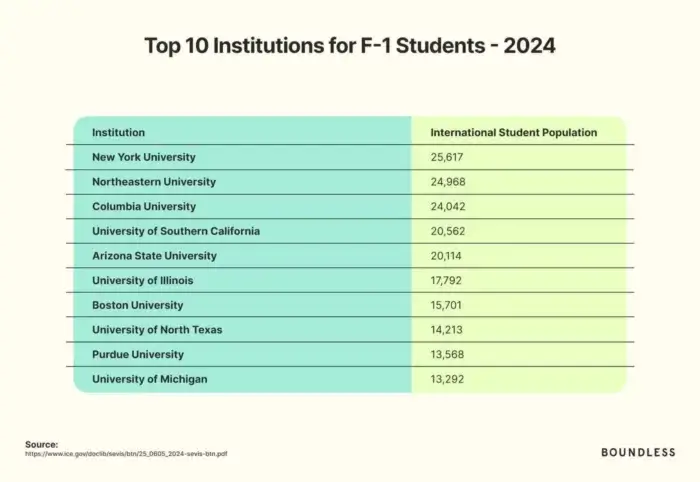
According to U.S. Immigration and Customs Enforcement (ICE), there were 1.08 million active international students in the U.S. in 2024, across more than 8,600 institutions.
- Students from India and China make up over 50% of that population.
- The U.S. education sector contributed nearly $45 billion to the national economy in 2024, according to NAFSA.
- DHS estimates that roughly 2.5% of all student visa holders overstay their authorized periods each year.
These numbers show that while some level of enforcement may be needed, the potential downsides—fewer enrollments, lost revenue, and brain drain—are substantial.
Practical Consequences for Students
Let’s look at how this plays out in real life.
1. Shorter Visa Validity
A student pursuing a Ph.D. in Engineering that typically takes 5–6 years will need at least one visa renewal, adding uncertainty and potential interruption to research work.
2. Increased Paperwork and Fees
Filing for extensions can cost hundreds of dollars, not counting attorney fees if legal help is needed. Some students may face months-long waits, risking lapses in their legal stay.
3. Stricter Rules for Transfers
Switching schools, majors, or research institutions will trigger new compliance checks and may require pre-approval by USCIS or DHS.
4. Reduced Flexibility for OPT/CPT
The Optional Practical Training program, which allows international graduates to work in the U.S. for up to 12 months (or 36 months for STEM fields), might face additional audits and limits. This could affect employers and industries that rely heavily on foreign STEM graduates.
5. Shorter Grace Period
The post-completion grace period, currently 60 days, could be reduced to 30 days under the new policy—cutting down time for job searches, OPT applications, or departure arrangements.
Practical Guide: How to Navigate the New Rule for US Student Visas
As a student, preparation is everything. Here’s what you can do right now:
Step 1: Understand Your Visa Timeline
Read your I-20 form carefully. It lists your program start and end date. Treat those as fixed deadlines and plan your graduation, thesis, and OPT timeline accordingly.
Step 2: Keep SEVIS Up-to-Date
Your Student and Exchange Visitor Information System (SEVIS) record is the government’s main way of tracking your status. Update it promptly if you move, transfer schools, or change majors.
Step 3: Maintain Full-Time Enrollment
Falling below full-time or taking too many online classes could lead to loss of status. Always consult your Designated School Official (DSO) before making enrollment changes.
Step 4: Apply Early for Extensions
Start your extension process 6–9 months before your visa expiration. Keep all documentation — transcripts, attendance records, and supervisor letters — ready to support your case.
Broader Reactions from the Education Community
Top U.S. universities are speaking out. The Association of American Universities (AAU) released a statement calling the policy “counterproductive,” noting that international students contribute to U.S. innovation, particularly in STEM.
Harvard University, MIT, and several state university systems are reviewing the potential impact and considering joint petitions against the proposed rule.
Beyond the campus gates, tech industry leaders are worried, too. Silicon Valley firms often recruit students through OPT and STEM OPT programs. If these pathways shrink, companies could lose access to thousands of skilled workers every year.
Global Impact: The U.S. vs. Competitor Nations
Other countries are already taking advantage of the uncertainty. Canada, for example, recently expanded its post-study work visa program, allowing international graduates to work up to three years after finishing their degree.
The United Kingdom reintroduced its Graduate Route visa in 2024, offering similar flexibility. Meanwhile, Australia has been increasing scholarships and easing visa conditions to attract more students from Asia.
If the U.S. makes studying more complicated, these nations stand ready to welcome the world’s brightest minds instead.
Career Planning in the New Visa Landscape
If you’re planning to study in the U.S. under the new rule, it’s time to think strategically.
- Choose programs that align closely with your career goals and can be completed within four years.
- Build relationships with your international student office — they’ll be your lifeline for compliance.
- Network with alumni and employers who understand visa processes.
- Keep your resume and portfolio ready to apply for OPT or H-1B opportunities as early as possible.
Employers are more likely to sponsor students who show initiative, solid academic performance, and clear career focus.
Texas SNAP Payments Set for December 8–14 — Check Payment Dates and Eligibility Criteria
VA Cremation Payouts Revealed: How Much Can Your Family Really Get?
Free iPhones for EBT Users? 2025 Program Details & How to Apply Now